

The City That Never Stops Eating
There is a particular kind of madness to dining in Dubai in 2026. Not the bad kind — the sort that comes with abundance, with too many excellent choices and not enough evenings to explore them all. Over 13,000 licensed restaurants. Three new ones opening every single day. A Michelin Guide that has gone from 11 stars at launch in 2022 to 19 in four years, including — for the first time anywhere in the Middle East — two restaurants at the guide’s highest three-star level. Trying to keep up with Dubai restaurant trends 2026 is a full-time job — new restaurant openings are arriving faster than anyone can track — and even the people whose full-time job it is will admit, quietly, that they’re falling behind.
But here’s what’s interesting beneath all the noise. Dubai’s restaurant boom isn’t just about volume anymore. It’s about specific cuisines gaining serious ground: Japanese restaurants in Dubai have quietly colonised every price tier in the city; Korean dining in Dubai has gone from a cluster of barbecue spots in Deira to earning its own dedicated category at the Time Out Dubai Restaurant Awards; and luxury dining in Dubai no longer needs to borrow its credibility from London or New York. It’s building its own.
This report looks at how those three forces are reshaping Dubai’s food scene and culinary landscape right now — and where the cracks are starting to show in the context of the Dubai dining report 2026.
Dubai Dining at a Glance — 2025/2026
| 13,000+ Licensed Restaurants | 19 Michelin Starred (2025) | 240+ New F&B Opens H1 2026 | 200+ Cuisines Represented |
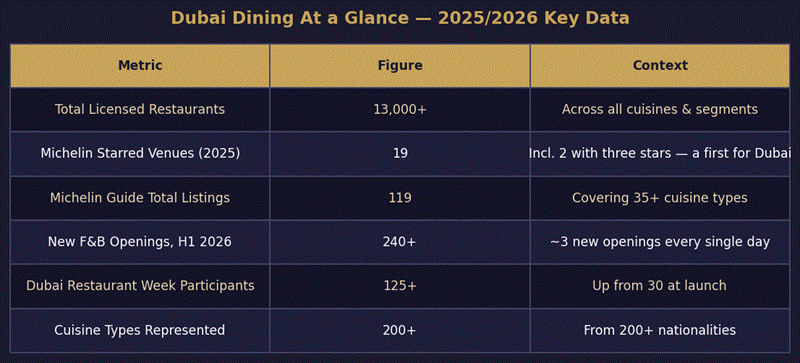
Dubai Dining Key Metrics — 2025/2026 Data Summary. Source: Michelin Guide, Dubai DET.
Michelin: Four Years In, and Dubai Is Playing for Real Now
When Michelin came to Dubai in June 2022, the reaction in the industry was split. One half was thrilled. The other half worried, not without reason, that the guide’s presence was more about market expansion than culinary rigour — that the stars would be handed out generously to justify a new territory, then quietly recalibrated once the fanfare died down.
Four years in, those doubts look misplaced. The 2025 edition — the fourth — listed 119 restaurants across 35-plus cuisine types — Michelin-starred restaurants in Dubai now spanning 35 cuisine categories. What really silenced the sceptics: it awarded three Michelin stars to two Dubai restaurants for the first time: the highest distinction the guide gives, meaning food worth travelling specifically to eat. The guide saying, in its most formal possible language, that Dubai belongs in the same conversation as Paris, Tokyo, and Copenhagen.
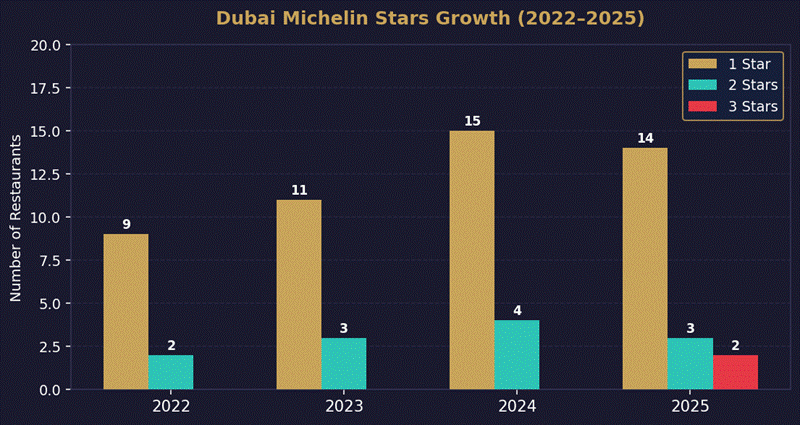
Dubai Michelin Star Growth by Category, 2022–2025. Source: Michelin Guide Dubai official announcements.
FZN and Trèsind Studio: The Restaurants That Changed the Argument
FZN by Björn Frantzén is the kind of restaurant that could exist almost anywhere money pools and ambition concentrates. Frantzén’s Stockholm original has three stars; the Dubai outpost earns the same through a long tasting menu that weaves Scandinavian restraint with Japanese technique — cold precision softened by warmth, if you want the cliché, though the food earns it. It’s exceptional. It’s also, if you’re being honest, the less surprising of the two three-star recipients.
Trèsind Studio is the one that matters more for what it says about Dubai specifically. Known internationally as Tresind Studio, Chef Himanshu Saini’s restaurant is progressive Indian cooking at its most serious — not Indian food filtered through French technique to make it palatable to a Western fine dining audience, but Indian cuisine on its own intellectual terms, using its own culinary logic to reach somewhere new. A dish that keeps coming up when people describe the current menu: pickled pepper, tangerine flowers, khandvi ice cream. On paper it sounds like a test. On the plate, by all accounts, it resolves perfectly. Its three-star rating is the clearest evidence yet that Dubai’s homegrown restaurant culture has stopped waiting for external validation and started generating it.
Away from the three-star headlines, the guide has real texture. Twenty-two Bib Gourmand picks cover the range from Lebanese canteens in Jumeirah to walk-in Japanese spots where you’d spend AED 60 on food that’d cost three times that in a hotel. The guide’s critics say it still skews toward hotel restaurants and premium DIFC restaurants and addresses. They’re not entirely wrong. But the direction of travel is good.
Japanese Cuisine: It’s Everywhere, and That’s Not a Complaint
There’s a version of this story where the prevalence of Japanese food in Dubai is a red flag — the culinary equivalent of a city that’s discovered avocado toast and won’t move on. That version is wrong. Japanese restaurants in Dubai have built an ecosystem over the past five years that is deeply varied, seriously skilled, and covering ground that very few cities outside Japan and a handful of major Western capitals can match.
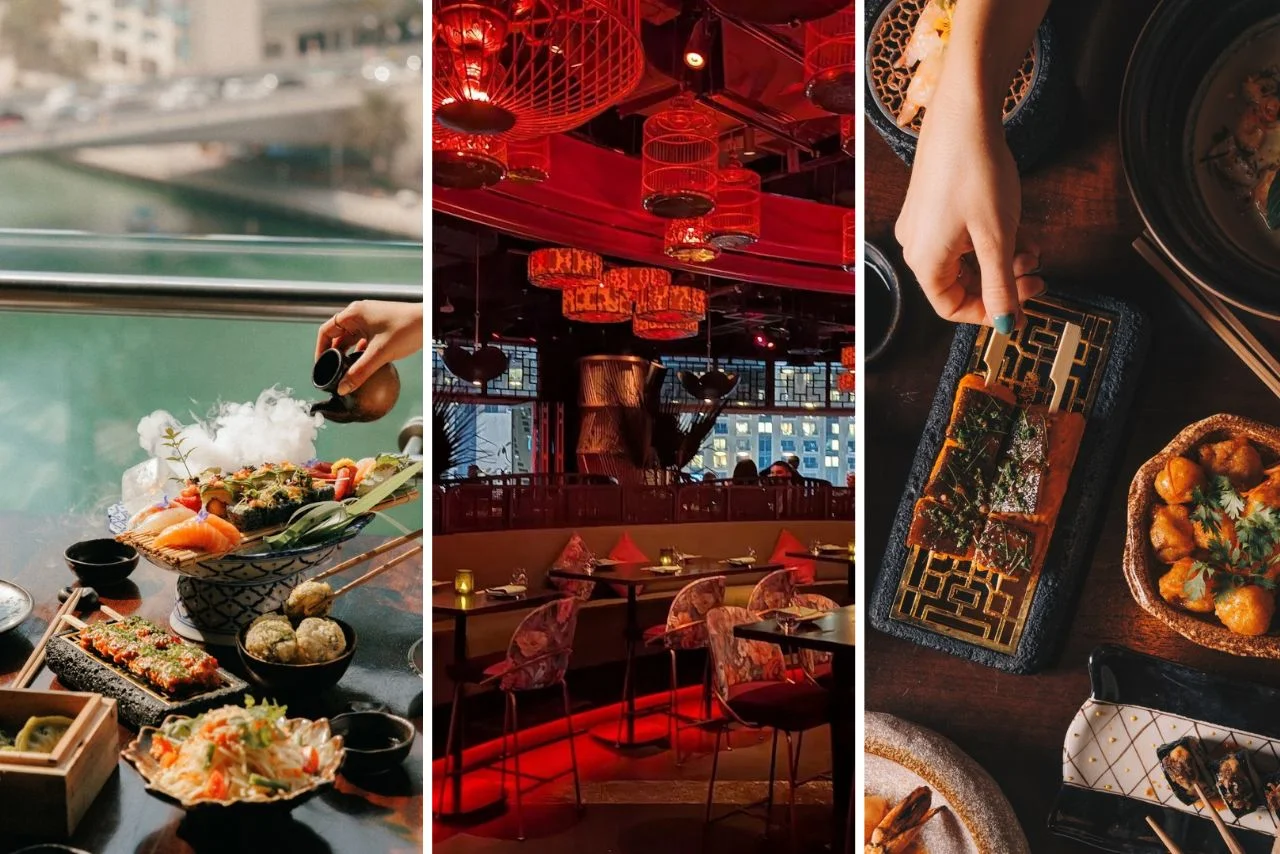
At the high end: omakase counters where twelve courses of fish and rice become an almost meditative experience — omakase dining in Dubai now rivals Tokyo in seriousness, sake pairings chosen with the seriousness of a sommelier’s wine list, and chefs who trained in Osaka or Tokyo and brought their instincts intact. At the casual end: izakaya dining in Dubai is actually fun, with robata grills you can lean over and shout across, and temaki bars where AED 40 buys something better than most of what gets called sushi in London. In between: the Nikkei category, which has arguably become Dubai’s most distinctive cuisine signature.
Nikkei: The Fusion That Stopped Apologising
Nikkei cuisine — Japanese cooking cross-pollinated with Peruvian ingredients, specifically the chillies, citrus, and seafood that characterise coastal Peruvian cooking — used to carry a slight air of novelty wherever it landed outside Lima. In Dubai, that’s finished. It’s a genre now, with its own audience, its own critical standards, and enough openings this year to constitute a category in its own right, not just a trend.
Chotto Matte Dubai brings a formula that has worked in London and Miami: loud, beautiful, expensive enough to feel like an event without being actively hostile to your bank account, and serious about the food in a way that the design almost distracts you from noticing. Osaka Nikkei, on the 35th floor of the Mandarin Oriental Downtown, is the flagship for Nikkei cuisine in Dubai — the view is doing work, but so is the kitchen, and the Peruvian-influenced tiraditos and ceviches hold up alongside the Japanese elements instead of being window dressing. Taiga is the most committed: teppanyaki and omakase built around A5 Wagyu and premium seafood, where the theatrical element of cooking in front of you is actually part of the flavour logic rather than a distraction.
The honest caveat: not every Nikkei opening in Dubai is as good as the best ones. The category is popular enough now that dilution is a real risk. A few spots are riding the aesthetic without matching the technique. Diners who know their ceviche from their tiradito will notice. Most won’t, which is precisely the problem.
Zuma, Izakayas, and Why Casual Japanese Is the City’s Most Consistent Pleasure
Zuma, the London-founded izakaya group whose Dubai outpost has been one of the city’s reliably excellent restaurants for years, added Zuma Beachhouse to its local footprint in 2026 — a looser, more waterfront version of the format that suits a city which increasingly eats with its feet in the sand. It’s not reinvention. It’s Zuma understanding what its audience wants on a Thursday evening versus a Tuesday, and building accordingly.
Neo Temaki, now open at the JW Marriott Marquis in Business Bay, takes a different angle: the temaki bar as quick-service premium, where the ritual of hand-rolled sushi becomes something you can do in forty-five minutes between meetings. It shouldn’t work as well as it does. Dubai’s appetite for Japanese food at every register keeps finding new expressions, and the market keeps absorbing them.
Japanese cuisine runs from AED 40 temaki to AED 1,500 omakase and covers more of Dubai’s dining spectrum than any other. Whether that’s growth or sprawl depends on who’s cooking.
Korean Food in Dubai: The Rise Was Faster Than Anyone Expected
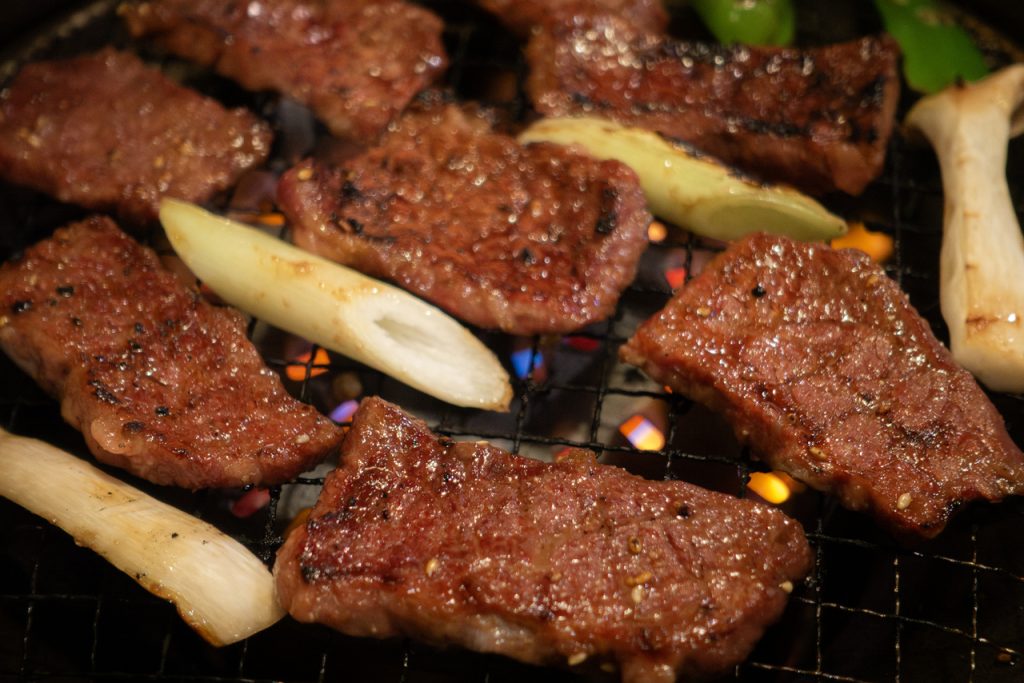
Five years ago, if you wanted serious Korean food in Dubai, you knew where to go: a handful of spots in Deira and around Al Barsha, mostly aimed at the Korean expat community, mostly excellent if you knew what to order, mostly invisible to the broader dining public. Korean dining in Dubai has changed significantly. That world still exists and it’s still good. But something has shifted on top of it.
Start with the numbers, because they’re hard to ignore. South Korean visitor arrivals to Dubai grew 225 percent in 2023. Then another 51 percent in the first half of 2024 alone. That’s not a trend; that’s a demographic realignment. A Korean audience arriving in those volumes travels with expectations — specific ones, about the quality of beef, about banchan, about what a proper galbi should taste like — and the city’s restaurant industry has responded.
The more interesting part of the story, though, isn’t the volume. It’s the ambition.
Hanu: Korean Barbecue as Fine Dining Argument
Hanu at St. Regis Gardens on the Palm is the clearest evidence that Korean food in Dubai has upgraded its own self-image. Hanu restaurant is striking — carved beam ceilings, dark walnut, antique Korean furniture that evokes a Joseon-era dining hall rather than a modern Seoul barbecue chain — and the beef, flown from Korea, is the kind of quality that makes the premium pricing feel like information rather than extortion.
The format — chefs grill the meat tableside, guiding you through cuts and timing — treats Korean barbecue not as the fun, messy, sociable thing it often is, but as a precision craft worth your full attention. Some guests will find that slightly earnest. Others will find it exactly what they came for. Either way, it’s a restaurant that takes a cuisine seriously, and Dubai was overdue one that did. It has become one of the city’s most sought-after reservations since opening, drawing both Korean visitors and a non-Korean audience encountering the cuisine presented at this level for the very first time.
Addition of a New Award Category, Pay Attention
The Dubai’s Restaurant Awards conducted by leading city guide has introduced a new category. The decision to add a dedicated Korean category for 2026 — for the first time in the awards’ history — is the kind of institutional signal that confirms what anyone paying attention already knew: Korean cuisine in this city has critical mass. It’s not niche. It’s not emerging. It’s here.
Romantic Baka and Shogun are doing the work at more accessible price points, building the regular-Tuesday audience that luxury operators depend on existing before they open. The full range — from a quick bibimbap to a multi-course Korean tasting experience — is now available in Dubai, which is the mark of a cuisine that has properly landed and put down roots.
Whether the fine dining push is sustainable — or whether Hanu-style Korean restaurants are a moment rather than a movement — comes down entirely to how good the food keeps being. Format and design open doors. Only the kitchen determines whether people come back.
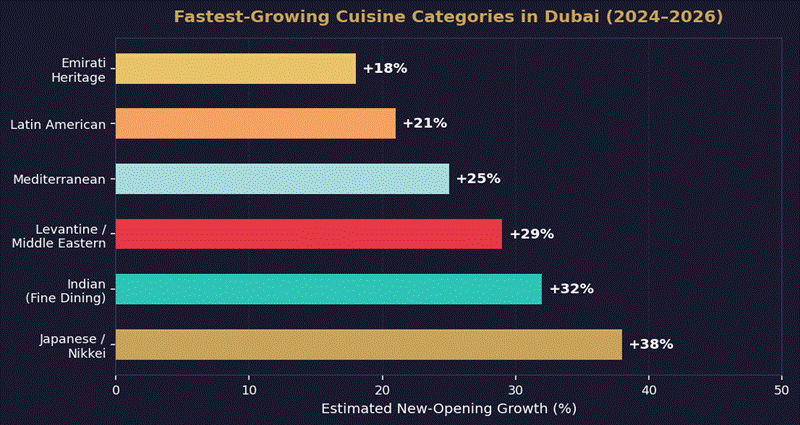
Fastest-Growing Cuisine Categories in Dubai by Estimated New-Opening Growth, 2024–2026.
Luxury Dining: The Ceiling Keeps Moving Up
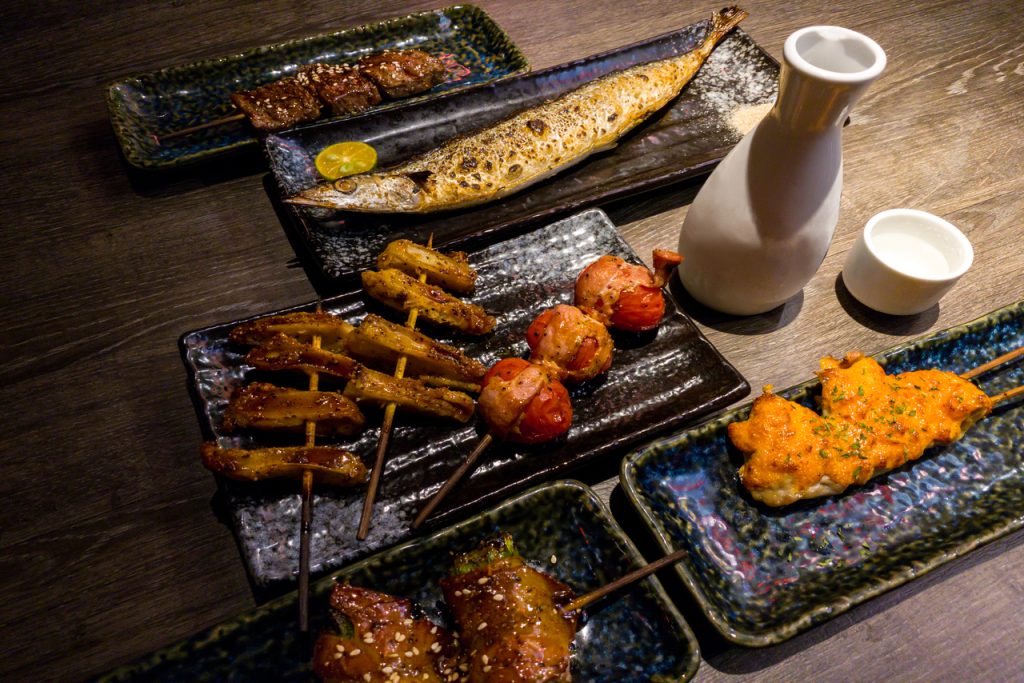
Dubai has never been short of expensive restaurants. Restaurants where the price actually reflects the food, though — that’s been harder to find. That’s changing, and the Michelin three-star moment is the clearest evidence. But the shift runs deeper than two restaurants.
The hotel-anchored celebrity chef model — bring in a famous name, attach it to an F&B outlet, watch the bookings fill on brand recognition alone — is under genuine pressure, perhaps for the first time in Dubai. Not because those restaurants have got worse, but because the alternatives have got so much better. When Trèsind Studio earned three Michelin stars as an independent concept, the argument for paying a premium for a globally exported hotel restaurant format became harder to make.
Barrafina and Gymkhana: What London’s Best Choosing Dubai Means
Barrafina’s Dubai opening — its first international location — is worth unpacking. The original Soho tapas bar is, by the standards of its format, almost aggressively uncommercial: no reservations, counter seating only, a menu of maybe thirty items that changes daily, zero tolerance for inconsistency. It has worked in London because the product is good enough to justify the friction. Choosing Dubai as the place to extend that for the first time says something specific about the market here: that there is an audience sophisticated enough to understand what Barrafina is doing and willing enough to actually show up for it.
Gymkhana’s Dubai opening in DIFC tells a similar story about high-end Indian cooking. The London original earned its Michelin star by treating Indian cuisine’s colonial-era club tradition as a serious design and culinary reference point and not as a nostalgic costume. In a city where Trèsind Studio received three stars for a different but equally rigorous take on the same tradition, Gymkhana steps into a category that Dubai’s dining public already takes seriously. That’s a better position than most international restaurants find themselves in when they arrive.
The Booking Problem Nobody Talks About Enough
Here is the practical reality of luxury dining in Dubai in 2026: if you want to eat at the best restaurants in Dubai this year on a Saturday night, you need to be organised in a way that the city’s historically spontaneous dining culture has not prepared most people for. Three-star restaurants require four to eight weeks’ notice. Serious one-star spots are running two-to-six week waits for prime sittings.
For restaurants, this is an enviable problem to have. For Dubai as a dining destination, it creates a tension worth monitoring: a city that markets itself partly on ease and accessibility is producing a fine dining tier that is, increasingly, neither easy nor accessible unless you plan like you’re booking a flight. The visitors who have one week in Dubai and want the best table in town are discovering that ‘best’ and ‘available tonight’ are no longer synonymous. Whether that’s a feature or a bug depends entirely on who you ask.
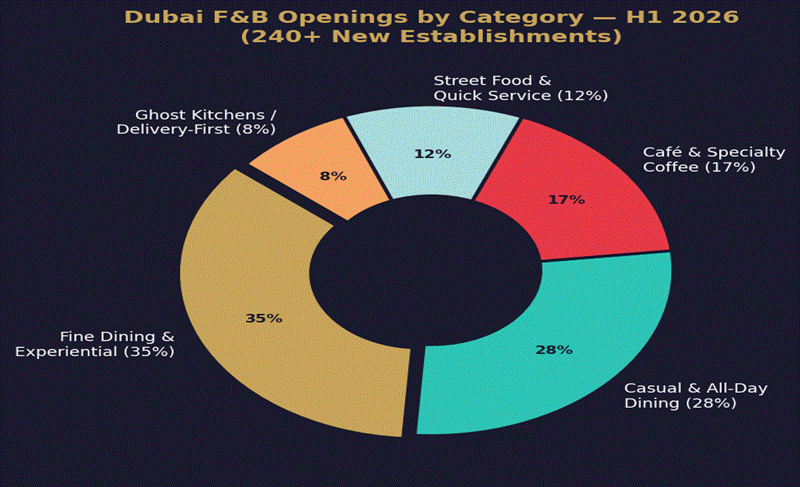
Dubai F&B Openings by Category, H1 2026. Fine dining and experiential concepts lead at 35%. Source: Dubai DET estimates.
Four Things Worth Watching
Sustainability: Finally Moving Past the Press Release Stage
For years, sustainability in Dubai’s restaurant industry existed primarily as marketing language — sustainable dining in Dubai was a label, not a practice. Menus said ‘locally sourced’; what they meant was ‘we bought some herbs from a farm in Ras Al Khaimah.’ The Michelin Guide’s three Green Stars in the current selection are meaningful partly because Michelin is notoriously rigorous about what earns them, and partly because they create a public benchmark that other restaurants have to respond to. The operators taking this seriously in 2026 are building actual supplier relationships with local hydroponic farms, designing zero-waste menus that aren’t just about food scraps but about the whole purchasing logic of the kitchen. It’s slower and harder than buying organic labels from a wholesaler. It’s also, finally, actually happening.
Homegrown Chefs: The Most Important Shift in the Market
Of everything in this report, the homegrown chef story is the one worth watching most closely. Homegrown chefs in Dubai are rewriting the rules of what this city’s restaurant industry looks like. The city provided the infrastructure and the customers; other cities provided the culinary identity. That model is fraying at the edges, and Orfali Bros is the clearest example of why. Three Syrian brothers cooking food that reflects where they come from have built one of the city’s most-loved restaurants, in a city that gave them the platform to do it at the highest level. Other chefs who trained in Dubai’s hotel kitchens are now launching independent concepts — in Alserkal Avenue, in Business Bay, in spaces that cost less than a DIFC launch and allow more creative risk — and that is exactly what a properly mature food city looks like. It’s a good sign. Arguably the best sign in this whole report.
Fusion Without Apology
The trend some call ‘cuisineless dining’ — menus that refuse to declare a national allegiance and instead build from technique, ingredient logic, and the chef’s own reference points — has found its most natural home in Dubai, partly because the city’s demographics make culinary boundary-crossing feel unremarkable, and partly because diners here have eaten widely enough to get the references. Iraqi-Japanese, Emirati-Mediterranean, Indian-Scandinavian: none of these read as gimmicks when executed with conviction. Done badly, it becomes a cover story for restaurants that haven’t committed to mastering anything. The good ones don’t have that problem. Telling the difference requires eating at them.
The Talent Gap Nobody Wants to Admit
Two hundred and forty new restaurants in six months require a lot of cooks, managers, and people who know how to run a service. Dubai’s culinary schools are producing graduates. Hospitality groups are training staff. International talent still flows in. But the pace of opening is faster than the pace of talent development, and in a market where customers have 13,000 options, an inconsistent kitchen doesn’t get a second chance. Several of the most hyped openings of the past eighteen months have already quietened — not closed, but quietened. The tables that were full at launch are now available within the same week. The operators who survive the next five years will be the ones who invested in their kitchens and their people, not just their fit-outs.
The restaurants that will define Dubai’s dining decade aren’t the ones with the biggest budgets. They’re the ones where the chef is still in the kitchen on a Tuesday.
Where This Goes Next
The sensible answer is: more of the same, but better calibrated. More Japanese openings, yes, but with new restaurant openings in Dubai now running at three per day, the category is mature enough that the weak ones will close. More Korean restaurants, with the first Michelin recognition of the cuisine in Dubai likely in the next one or two guide editions. More international brands choosing Dubai as a first international move rather than a fifteenth, which means the calibre of what’s arriving keeps rising.
The Michelin Guide’s 2026 Dubai edition is expected any day now — the ceremony typically falls in May or June — and will be the clearest indicator of where the city’s fine dining tier actually stands — and whether Dubai fine dining has genuinely earned its place among the world’s best. The 2025 edition’s three-star moment was historic. Whether it’s consolidated or expanded in 2026 will say a lot about whether Dubai’s luxury dining scene is actually deepening or simply had a very good year.
The Korean category is the one to watch most closely. The infrastructure is there. The demand is there. What’s needed is a critical mass of chefs building long-term culinary identities in Dubai and not treating it as a lucrative stopover. Hanu is a good start. It needs company.
As for the wider scene: Dubai is not becoming a great food city. It already is one. Dubai restaurant trends 2026 and Dubai’s food culture have moved on from that debate — the question now is what kind of great food city it wants to be. That’s a better argument to be having. Most cities never get there.
Dubai has stopped asking whether it’s a serious food city. Now it’s arguing about who gets to define what that means.
 1 AED
1 AED