

Travel trends come and go, but this one is here to stay for a pretty long time. It has been some time since the introduction of the EU Entry/Exit System (EES). Since 12 October 2025, tourists landing at different airports in the Schengen area have been required to pass through the EES, causing them to share some basic details and biometric information before entering the country. Manual stamping of passports has been replaced by automated border control checks. But has it been a seamless experience so far?
Let’s understand things from the UAE residents and citizens’ perspective. Dozens of people apply for the Schengen travel visa each year and many of them travel from or through Dubai International (DXB) to get to Europe. Emirates and flydubai operate daily flights at different timings. The EU Entry/Exit System is no less than a protective screen, helping keep the Schengen area safe and secure. But do UAE passport holders and those holding the UAE Residence Permit need to pass through the system?
Plus, there is the European Travel Information and Authorisation System (ETIAS) expected to become operational from later this year. The EES is part of this scheme only. If you are planning to travel to Europe from Dubai in 2026, keep some extra time aside. The first time takes the longest. By the second time, things get quicker and easier. From a basic understanding of the EU Entry/Exit System (EES) and its benefits to exceptions and the planned launch of ETIAS, take a look at all the things you may need to face on your next trip to Europe.
What is the EU Entry/Exit System?
No more stamping of passports. The European Union’s Entry/Exit System (EES) is an automated IT system for registering non-EU nationals travelling for a short stay, each time they cross the external borders of any of the European countries using the system, such as Austria, Belgium, Bulgaria, Croatia, Czechia, Denmark, Estonia, Finland, France, Germany, Greece, Hungary, Iceland, Italy, Latvia, Liechtenstein, Lithuania, Luxembourg, Malta, Netherlands, Norway, Poland, Portugal, Romania, Slovakia, Slovenia, Spain, Sweden, and Switzerland.
Here, a ‘non-EU national’ means someone not holding the nationality of any EU country or the nationality of Iceland, Liechtenstein, Norway or Switzerland. Plus, ‘short stay’ means up to 90 days in a 180-day period. But do UAE residents and citizens need to pass through the EES? That is a different story, depending on your passport. But if you are concerned about the Schengen visa, UAE passport holders do not need the visa to enter the territory for a short stay, but some UAE residents need the visa and some don’t.
Read More: https://travel-europe.europa.eu/en/ees
Do UAE Residents and Citizens Need to Register in EU EES?
Some need to and some don’t. The EU Entry/Exit System (EES) has been in operation since last year, helping to improve efficiency, reduce irregular migration, reduce Schengen visa overstaying, and make countries safer. For your first time, you may need to submit your personal information, fingerprints and a facial image. By the second time, it is a breeze. Your entries and exits, or entry refusals, are electronically registered in the system.
The EES applies to non-EU nationals travelling to Europe and:
- requiring a short-stay visa to travel to European destinations using the EES
- or, not requiring a visa to travel for a short stay in Europe using the EES
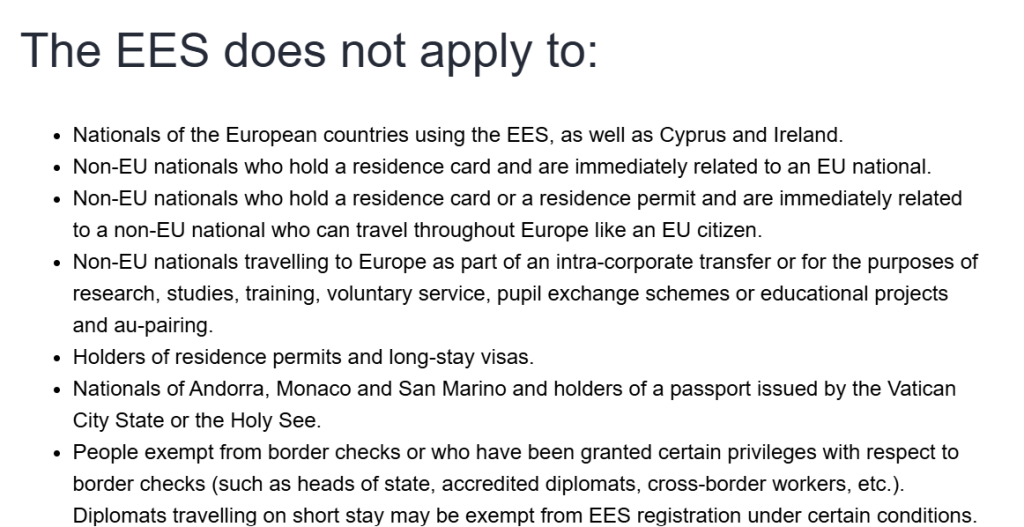
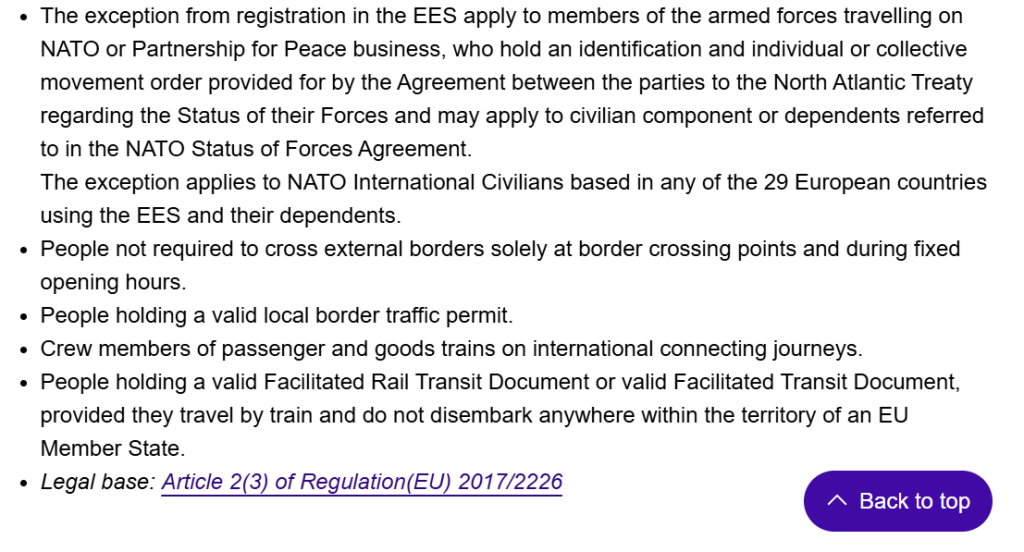
But there can be some exceptions. For example, tourists travelling to Cyprus and Ireland see their passports getting manually stamped, despite these countries being part of the EU. In other exceptions, the EU Entry/Exit System (EES) does not apply to:
- EU nationals using the EES, besides nationals of Cyprus and Ireland.
- Non-EU nationals holding a residence card and immediately related to an EU national.
- Non-EU nationals holding a residence card or a residence permit and immediately related to a non-EU national permitted to travel across Europe like an EU citizen.
- Holders of residence permits and long-stay visas.
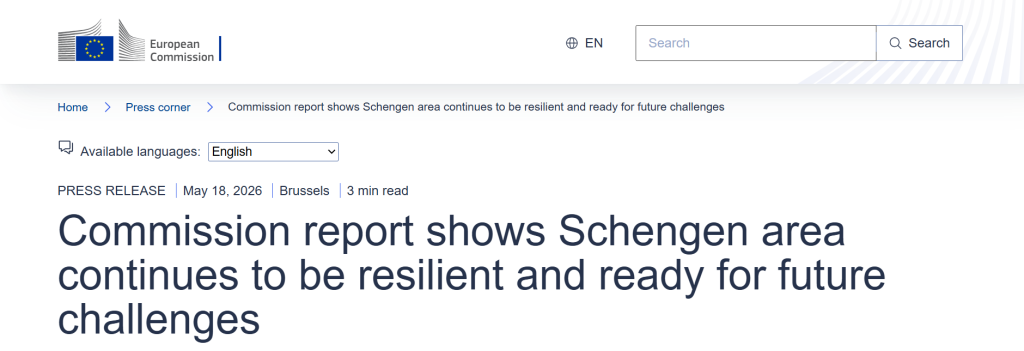
This is not the complete list, of course. Use the screenshots coming up next to understand the list of nationalities or travellers to whom the EU EES does not apply. UAE passport holders travelling to the Schengen area for a short stay need to pass through the EES. The same applies to a good number of UAE residents. The entire situation depends on the country’s passport you are carrying, the duration of your stay, and the purpose of your visit.
Which Nationalities Do Not Need to Pass Through EU EES?
What are the Benefits of EU Entry/Exit System?
You may be wondering if the European Union’s Entry/Exit System (EES) is actually serving a purpose. But there are four different goals it is trying to meet, besides prevention of Schengen visa overstaying and managing illegal migration. The EES is also helping make European destinations safed, something all of us planning to travel to Europe some day also look for. Take a look at all the benefits of the EU EES.
| More Efficient Border Checks | Gradual replacement of passport stamps as digital records take centrestage |
| Faster Cross-Border Travel | Faster checks, self-service options and the possibility to provide information prior to travelling – letting tourists spend less time at the border |
| Preventing Irregular Migration | Fingerprint and face data used to stop Schengen visa overstaying, fake identity use or misuse of visa-free travel |
| Increasing Security | Better access to information, helping authorities spot security risks and fight serious crimes |
What Information Does the EU EES Need You to Submit?
If it is going to be your first time travelling to Europe from the UAE since the introduction of the EU Entry/Exit System (EES), please spare some extra minutes for this procedure. But by the second time, the process becomes much simpler and quicker. The EU EES collects a set of personal details each time you reach the external borders of the European countries using the system. On the basis of the collected biometric data, biometric templates are created and stored in the shared Biometric Matching Service. If you hold a short-stay Schengen visa, your fingerprints are already going to be stored in the Visa Information System (VIS) and do not need to be stored again in the EU EES.
The EU Entry/Exit System collects, records and stores:
- Data listed in your travel document, such as full name and date of birth
- Date and place of each entry and exit
- Biometric data, such as fingerprints and facial image
- Refusal of entry, if any
Check Here: https://travel-europe.europa.eu/ees/data-held-by-ees
Can I Refuse to Provide My Biometrics for EU EES?
If you refuse to have your fingerprints scanned or a photo of your face taken for the EU Entry/Exit System (EES), you cannot enter the territory of the European countries using the system. Please be assured that your data protection rules and rights are fully respected at the time of data collection and storage. Therefore, please comply.
What is the Use of Travel to Europe Mobile App?
If you are a non-EU traveller required to handle the EU EES registration, the Travel to Europe app is going to be of immense use to you. You can pre-register your passport data and facial image before reaching a border crossing point (that uses the mobile app). Plus, don’t forget to fill in the entry conditions questionnaire prior to travelling. You can do all of these at most 72 hours before entering or leaving a European country using the app. Please keep in mind that the Travel to Europe app is not a replacement for border checks. It just makes border crossing smoother, faster and more efficient.
Travel-to-Europe Install Here – Google Play Store
Travel-to-Europe Install Here – App Store
When is the EU ETIAS Getting Launched?
The entire scenario around travel to Europe is changing fast. Starting from the last quarter of 2026, some 1.4 billion people from 59 visa-exempt countries and territories are going to need to have a travel authorisation to enter 30 European countries for a short stay. This is the European Travel Information and Authorisation System (ETIAS) and the EU EES is also part of it. But is it something to fear or something to hail?
The EU ETIAS travel authorization, in simple terms, is an entry requirement for visa-exempt nationals travelling to any of the 30 countries in the region: Austria, Belgium, Bulgaria, Croatia, Cyprus, Czechia, Denmark, Estonia, Finland, France, Germany, Greece, Hungary, Iceland, Italy, Latvia, Liechtenstein, Lithuania, Luxembourg, Malta, Netherlands, Norway, Poland, Portugal, Romania, Slovakia, Slovenia, Spain, Sweden, and Switzerland.
- ETIAS is linked to your passport.
- If you get a fresh passport, you need to get a fresh ETIAS travel authorization.
- ETIAS is valid for up to three years or until your passport expires (first one to come)
- ETIAS travel authorisation permits you to enter the territory of 30 European countries as often as you need to for short-term stays (up to 90 days in a 180-day period, generally)
- ETIAS does not guarantee entry.
Check Here: https://travel-europe.europa.eu/etias/about-etias/what-is-etias
Schengen Visa Overstaying Tightly Regulated by EU EES
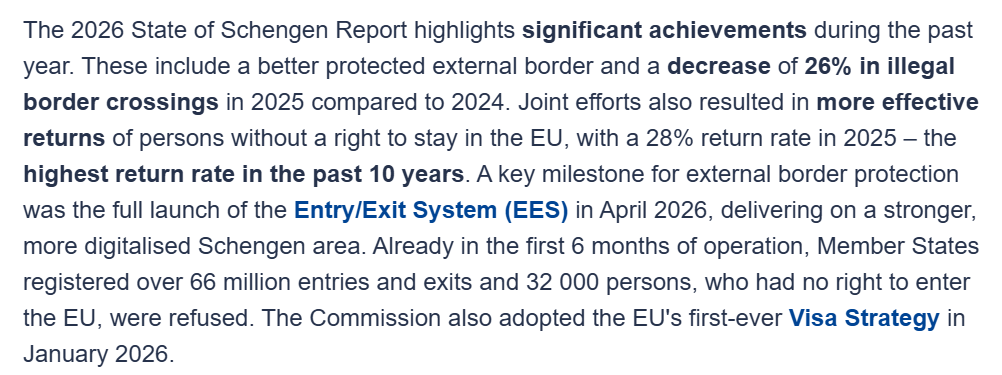
Released on 20 May 2026, the annual State of Schengen report has found something interesting about the EU Entry/Exit System. In the first six months of the digital border system’s introduction, 7,000 travellers have been caught overstaying their permitted time limit in the Schengen area. Penalties for such crimes range from a fine to a ban on entering the EU. Therefore, do not ever overstay your Schengen visa, no matter the temptation you may get because of a country’s natural beauty, nightlife, food or other offerings.
Since October 2025, Europe’s borders have recorded more than 66 million entries and exits of non-EU nationals. In that span, on the other hand, about 32,000 people did not get the green light to enter the Schengen area. Last year, this territory remained the most visited destination across the globe, luring more than 790 million travellers. Travel demand remains strong and 2026 is also going to see some strong numbers, despite the geopolitical scenes globally. Doesn’t it sound promising?
Read More: https://etias.com/articles/ees-catches-7,000-overstays-in-first-6-months
What has been the Tourists’ Response to EU EES?
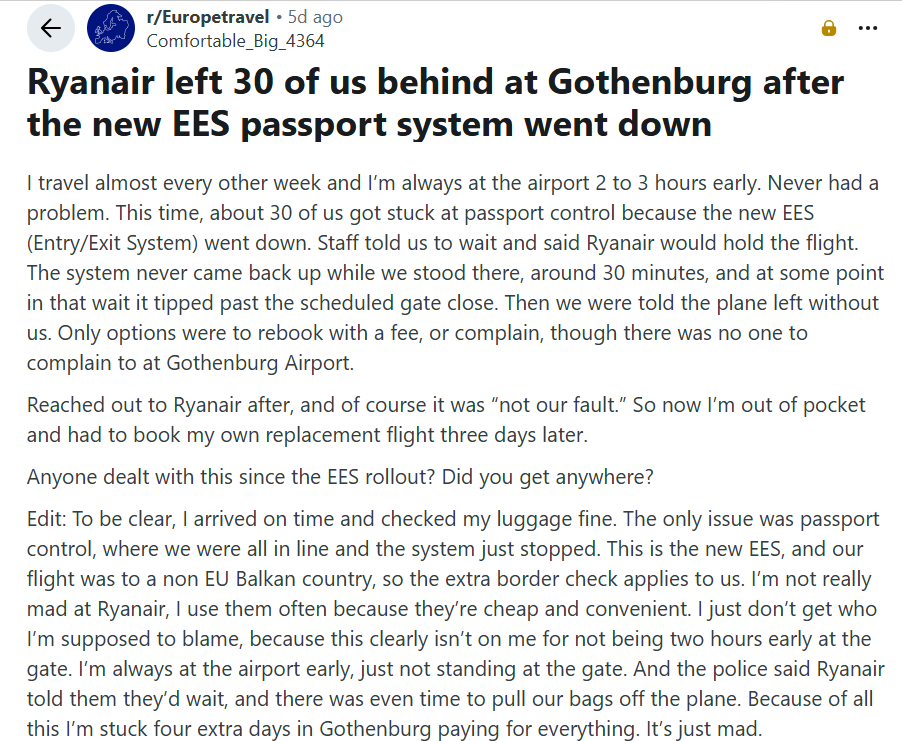
No doubt, the EU EES has been doing an incredible job at managing illegal migration and reducing Schengen visa overstaying. But some travellers are not happy. If you go on Reddit, one user (Comfortable_Big_4364) said: ‘Ryanair left 30 of us behind at Gothenburg’, because the EU Entry/Exit System did not perform in the manner it should. But this is not an isolated incident of any sort. There is more to it.
Back in February, the International Air Transport Association (IATA) released an update titled: ‘Travel trouble ahead if EU fails to address EES issues’. Summer Europe travel is right around the corner and the European Union needs to take care of all the issues different airports, airlines and passengers have been highlighting to manage the peak season better. Each issue needs to be taken care of at the earliest, such as:
- chronic border control understaffing
- unresolved technology issues
- very limited uptake of the Frontex pre-registration app by Schengen states
Read More: https://airlines.iata.org/2026/02/24/trouble-ahead-if-schengen-fails-address-entry-exit-system
EU Entry/Exit System (EES): In a Nutshell
Let’s zoom out. The EU Entry/Exit System is trying to manage a lot of issues, such as illegal migration, Schengen visa overstaying, and safety concerns. Since its introduction back in October 2025, the EU EES has been doing quite a great job at managing the overstaying problem. Then again, many passengers are complaining about the system delaying procedures, causing some people to even miss their flights. This means that not all things are great. The EU needs to take care of the highlighted issues as early as possible, as the peak summer travel season is right around the corner.
Travel to Europe is changing. The ETIAS travel authorisation is getting launched later this year and you could be seeing more changes to your plans. But do not fret. You can use our Schengen visa guide (overall and separate ones for each country) to apply for the visa better. There are ample flights from Dubai to different parts of Europe. Plan your itinerary much prior to your intended travel date. Install the Travel to Europe mobile app to handle the EU EES better. Your best trip of a lifetime needs just a handful of clicks.
EU EES and ETIAS: Frequently Asked Questions (FAQs)
1. What does the EU EES do?
The EU Entry/Exit System (EES) is replacing manual stamping of passports for digital records. It applies to non-EU nationals travelling to the Schengen area for a short stay and possessing a short-stay visa or not requiring a visa to stay for a maximum of 90 days in a 180-day period.
2. What biometric identifiers does the EU EES store?
Depending on different travellers, the EU EES stores different biometric identifiers, such as fingerprints and facial images.
– If you need a short-stay visa to travel to Europe, the system is going to store just your facial image, as your fingerprints are already registered.
– If you do not need a visa, four of your fingerprints and a facial image are going to be registered.
– The fingerprints of children under 12 years of age are not being scanned, currently.
3. Can I use the EU EES self-service system?
To use the self-service system at the border points, you need to have a biometric passport. This kind of passport contains a chip that stores your biometric information collected at the time of applying for the travel document.
4. Do I need a biometric passport to cross European borders using the EES?
Not necessarily. The biometric passport is only required for automated checks. European Union countries accept most travel documents, including biometric and non-biometric passports, in general. Therefore, do not be too concerned.
5. When is the ETIAS travel authorisation getting launched?
You can expect the system to get operational by the end of this year.
6. Is the EU EES registration free?
Yes. You do not need to pay a single Euro for the EU Entry/Exit System (EES) registration.
Europe Travel Visa from UAE Made Easier!
Schengen Visa for Germany
Documents, processing time & fees explained
Schengen Visa for Italy
Travel from UAE to Italy like a pro
EU Entry/Exit System (EES) for UK Nationals
Expectations, eligibility and procedure
Schengen Visa for Portugal
Explore eligibility, documents, fees and more
Schengen Visa for Iceland
Explore the land of ice and fire at ease



 1 AED
1 AED